9 Somatic Exercises You Can Do From Your Couch (Beginner-Friendly)
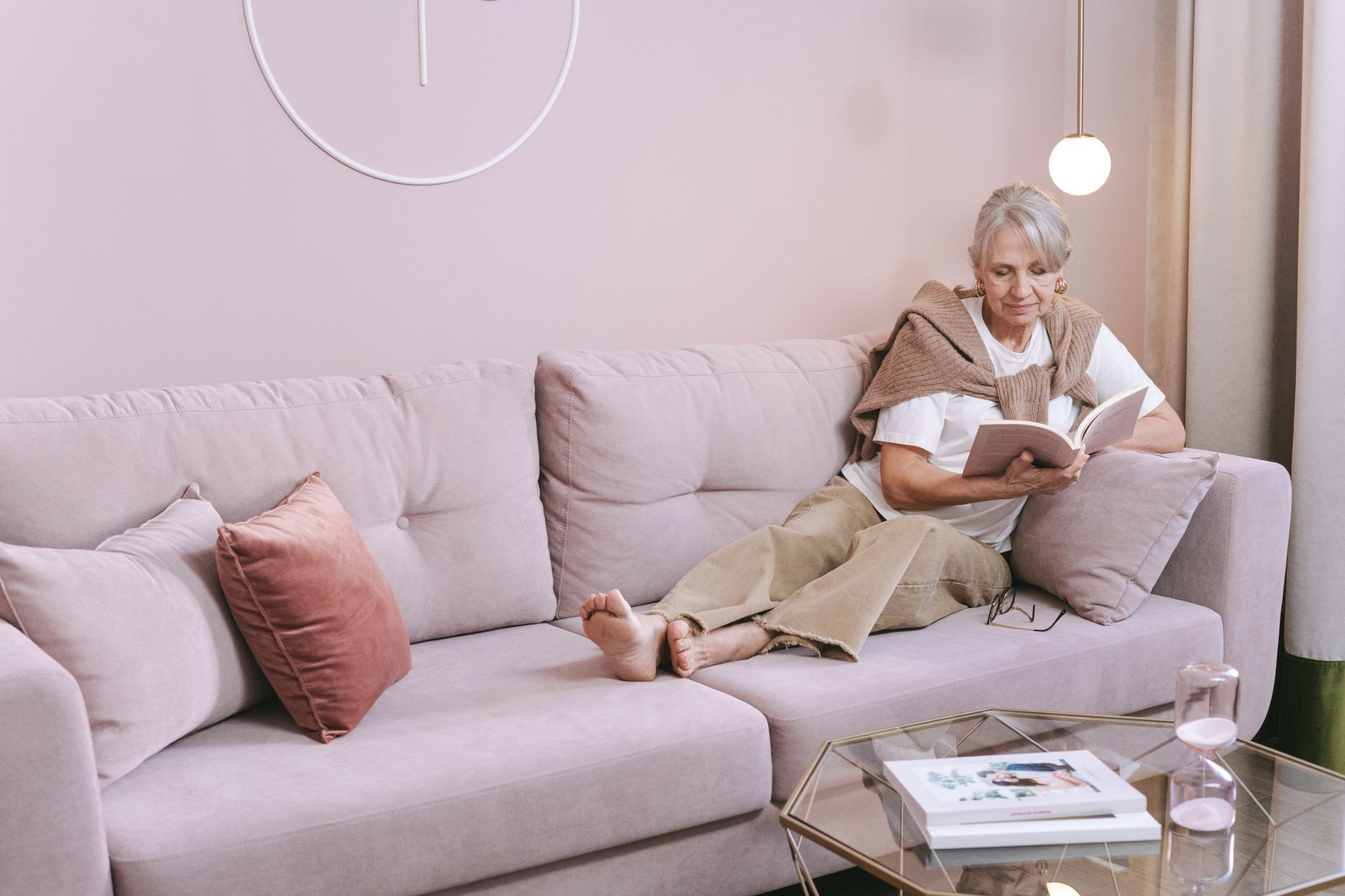
There was a stretch last winter when I would get home from an ordinary day feeling like I’d run a marathon in my own head — wired but tired, jaw tight, unable to sit still or actually rest. What finally shifted things for me wasn’t a complicated routine; it was learning a handful of tiny, body-based practices I could do exactly where I collapsed at 6 p.m.: on the couch.
The short answer: somatic exercises are simple physical practices — slow exhales, gentle self-touch, humming, rocking, orienting — that help a busy body settle without needing willpower or a quiet mind first. All nine practices below can be done seated on your couch, take one to five minutes each, require zero equipment, and work best when you pick one and repeat it often rather than trying all nine at once.
Why the couch is actually the perfect place to start
Most of us imagine that body-based practices require a yoga mat, a candle, and forty free minutes. In my experience, that expectation is exactly why we never start. The couch is where your body already goes when it’s done for the day — which makes it the most honest starting point there is. You’re already seated, already supported, already half-surrendered.
Starting where you land also removes the biggest barrier for sensitive, easily overstimulated people: the transition. You don’t have to change clothes, clear a space, or summon energy you don’t have. You just notice you’ve landed, and you begin. Every practice below is designed for exactly that moment — the one where you’re too drained to “do a practice” but too buzzy to actually rest. That in-between state is precisely where these small movements do their quietest, best work.
Quick reference: which exercise, when
| Exercise | Time | Best moment |
|---|---|---|
| 1. The long exhale | 1–2 min | Right when you sit down after a demanding day |
| 2. The self-hold | 2–3 min | When you feel scattered or untethered |
| 3. Humming into the chest | 2–3 min | Wired-but-tired evenings |
| 4. Slow orienting | 1–2 min | When your mind is racing ahead of you |
| 5. Butterfly taps | 2–4 min | Before a hard conversation or after one |
| 6. Feet-into-floor press | 1–2 min | Mid-scroll, when you realize you’ve gone numb |
| 7. The cushion press | 1–2 min | When you feel crowded or “too full” of the day |
| 8. Gentle rocking | 3–5 min | The restless hour before bed |
| 9. The couch cocoon scan | 5 min | Sunday afternoons; any full-system wind-down |
The 9 exercises
1. The long exhale
Sit back, let the couch take your full weight, and breathe in through your nose for a count of four. Then exhale slowly — through pursed lips or a soft sigh — for a count of six. That’s it. Repeat for eight to ten breaths, letting each exhale be a little lazier than the last.
The extended exhale is the single most beginner-friendly practice I know, because your body already does it naturally — every spontaneous sigh is your system trying to downshift. Harvard Health has written about how slow, deliberate breathing is one of the most accessible ways to invite the body’s natural relaxation response, which matches what this practice feels like from the inside. You might notice your shoulders dropping away from your ears around breath four or five, or a subtle warmth spreading through your chest. Use it the moment you sit down after work, in the car before you walk inside, or anytime you catch yourself holding your breath.
2. The self-hold
Place your right hand flat over your heart and your left hand over your belly. Let both hands be heavy and warm — no rubbing, no adjusting anything, just contact. Close your eyes if that feels okay, and simply feel the weight of your own hands for two to three minutes.
This one felt awkward to me at first, and then became the practice I reach for most. There’s something about steady, unhurried touch that gives a scattered body a boundary again — a felt sense of “here is where I begin and end.” You might notice your breath deepening on its own, or a slight softening behind your sternum. It’s my go-to for those untethered afternoons when I’ve absorbed everyone else’s energy and can’t find my own.
3. Humming into the chest
Take an easy breath in, and on the exhale, hum — low, quiet, unhurried, like you’re absent-mindedly humming while making tea. Keep your lips closed and let the vibration buzz in your chest and throat. Do five to eight hums, resting for a breath between each one.
The vibration is the point, not the tune. Researchers are exploring how slow exhalation and vocal vibration may gently influence the body’s rest-and-settle pathways — the NIH’s National Center for Complementary and Integrative Health keeps a plain-language overview of what’s known about relaxation techniques so far — and while the science is still unfolding, what I can tell you is how it feels: like someone turned the static down a notch. You might notice a pleasant heaviness in your limbs or the urge to yawn — both good signs. Perfect for wired-but-tired evenings when your body wants rest but won’t cooperate.
4. Slow orienting
Without moving your body, let your eyes travel slowly around the room. Land on one object at a time — a lamp, a plant, the corner of a picture frame — and actually look at it for a few seconds before drifting to the next. Let your head follow your eyes if it wants to. Continue for one to two minutes.
Orienting sounds almost too simple to count as a practice, but it’s one of the oldest tricks a body has: scanning the environment and confirming, at a felt level, that this room is ordinary and okay. You might notice a spontaneous deep breath partway through — that’s often the moment something lets go. Use it when your thoughts are sprinting ahead into tomorrow and you need to come back to the room you’re actually in.
5. Butterfly taps
Cross your arms over your chest so each hand rests on the opposite upper arm or shoulder. Now tap gently — left, right, left, right — in a slow, steady rhythm, like a lazy heartbeat. Continue for two to four minutes, letting the pace stay unhurried.
The alternating rhythm gives a busy mind something soothing and bilateral to follow, the way a slow walk does. I use this one before conversations I’m dreading and after conversations that took more out of me than expected. You might notice your thoughts getting a little less sticky, or a sense of being gently rocked from the inside. If tapping feels like too much on a raw day, simply squeezing each arm alternately works beautifully too.
6. Feet-into-floor press
Plant both feet flat on the floor. Slowly press them down — as if you could push the floor away from you — building to about half your strength over five seconds. Hold for a breath, then release just as slowly. Repeat three to five times.
This is the practice I use when I look up from my phone and realize I’ve been scrolling in a fog for twenty minutes, half-gone from my own body. The deliberate muscular effort followed by deliberate release is like a firm, friendly hand on the shoulder: you’re here, you have legs, the ground is holding you. You might notice tingling in your feet or a general sense of arriving back in the lower half of your body. Grounding, in the most literal sense.
7. The cushion press
Take a couch cushion and hug it against your chest, or place your palms flat against it and press slowly outward, as if calmly making space in front of you. Press for five seconds, release for five. Repeat five or six times, breathing normally.
There’s a particular end-of-day feeling I’d describe as being “too full” — crowded by everything and everyone you’ve carried since morning. Pushing against something solid gives that feeling somewhere to go. The body gets to physically enact making room, and something in the chest tends to soften in response. You might notice a satisfying tiredness in your arms afterward, or a sense of having a little more space around you. Use it when the day feels like it’s still sitting on you.
8. Gentle rocking
Sitting upright-ish, begin to rock slowly — forward and back, or side to side, whichever your body prefers. Keep it small and rhythmic, the pace of a porch swing rather than a metronome. Let it continue for three to five minutes, eyes closed or half-closed.
Rocking is the original settling practice; we do it for babies for a reason, and adult bodies never stop responding to it. On restless nights when I feel too keyed up to lie down, this is what bridges the gap. You might notice your breath syncing with the movement, or a drowsy, floaty quality arriving around minute three. It pairs wonderfully with a hum (exercise 3) if you want a fuller wind-down. This is the one I recommend for the twitchy hour before bed.
9. The couch cocoon scan
Arrange yourself for maximum comfort — blanket, cushions behind your back, feet up if possible. Then, starting at the top of your head, let your attention drift slowly downward through your body: forehead, jaw, shoulders, chest, belly, hips, legs, feet. At each stop, just notice what’s there without changing it. Take about five minutes for the full journey.
This is the closest thing on this list to a complete reset, and the one I save for Sunday afternoons or the end of especially long weeks. The body scan is a longtime staple of mindfulness practice — the Mayo Clinic includes a version of it among its beginner mindfulness exercises — and the couch-cocoon edition simply adds blankets. You might notice areas you didn’t know were braced — my jaw surprises me every single time — and a heavy, sinking comfort as the scan moves down. It’s the practice that eventually led me deeper into structured routines like the ones in The Somatic Reset, which strings these small moments into a full daily rhythm.
A simple 5-minute couch sequence to start tonight
If nine options feel like eight too many, here’s the exact mini-sequence I’d hand a friend who’s brand new to this:
- Land. Sit down, feel the couch holding you, and take one unforced breath. (30 seconds)
- Long exhale. Four counts in, six counts out, for six breaths. (1 minute)
- Feet press. Three slow presses into the floor to arrive in your body. (1 minute)
- Self-hold. One hand on heart, one on belly, and just stay. (2 minutes)
- Notice. Ask yourself: what’s one thing that feels 5% softer than when I sat down? (30 seconds)
That’s the whole thing. Done nightly, this tiny ritual does more than an elaborate routine you manage twice a month.
How to choose without overthinking it
Here’s the honest guidance: don’t try to master all nine. Pick the one that made you think oh, that sounds nice while reading — that instinct is usually your body voting — and do it daily for a week before adding anything else. Small and repeated beats ambitious and abandoned, every time.
Match the practice to the felt state rather than the clock. Buzzy and restless calls for movement-based options like rocking or the cushion press; foggy and checked-out responds better to the feet press and orienting; scattered and spread-thin tends to soften with the self-hold and butterfly taps. And if you’re the kind of person who absorbs the moods of every room you walk through, the settling practices here pair naturally with the boundary-focused rituals in The Architecture of Energetic Protection — settling your own system first makes protecting it much easier. Start with one practice, one couch, one week. Notice what changes.
FAQ
How long before I notice anything from somatic exercises? Often within the practice itself — a spontaneous sigh, dropping shoulders, or a yawn are immediate signs your body is responding. The deeper shift, where settling becomes easier to access on hard days, tends to build over two to four weeks of small daily repetition. Consistency matters far more than duration; two minutes daily outperforms twenty minutes once a week.
What if I feel nothing at all when I try these? Completely normal, especially at first. Many of us have spent years politely ignoring our bodies, so the noticing muscle is simply out of practice. Stay with the physical instructions — press the feet, hum the hum — and let sensation arrive on its own timeline. “Nothing yet” is a starting point, not a verdict.
Can I do these exercises lying down instead of sitting? Almost all of them, yes. The long exhale, humming, self-hold, butterfly taps, and body scan translate perfectly to lying down. The feet-into-floor press and rocking work best seated, but you can adapt the press by pushing your feet against the arm of the couch. Comfort is the priority — an awkward position works against the whole point.
Is it better to do these in the morning or evening? Whenever your body most needs settling, which for most people is the evening transition after work. That said, sixty seconds of the long exhale or feet press in the morning can change how braced you are walking into the day. The table above suggests a best moment for each, but treat those as invitations rather than rules.
Do I need any equipment or a special space? No — that’s the entire premise. A couch, a cushion you already own, and a few unclaimed minutes are the full kit. If you enjoy extras, a weighted blanket deepens the cocoon scan and dim lighting helps the evening practices, but none of it is required. Begin with what’s already in the room.
Sources: Harvard Health — Relaxation techniques: Breath control helps quell errant stress response · NCCIH (NIH) — Relaxation Techniques: What You Need To Know · Mayo Clinic — Mindfulness exercises
This is a wellness practice, not medical advice. If you’re struggling, please reach out to a qualified professional.